
Articles
ESPERANZA
Spiller Family History - From Virinia to Texas
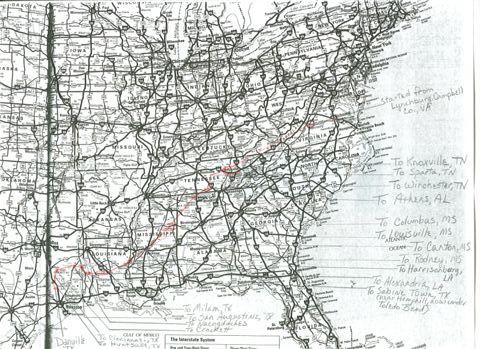
Their first child, a daughter named Allace Lucy, was born April 26, 1845 but did not survive. William was their second child and had been born on January 6, 1847. The family tale is that William learned to walk on the journey. The route that they took was documented by George in a diary that he kept and in letters that he wrote home once they arrived in Texas and is marked in red on the map below. Click here for a larger view.
George Spiller’s first land purchase after arriving in Danville was on 13 Dec 1849 when he bought 258 acres in the Joseph Lindley Survey from his brother, Dr. Samuel Fielding Spiller, who had arrived in Danville ca. 1846-’47. This land was located south of present-day Shepard Hill Rd. and adjacent to land owned by Iredell Reding. However, they didn’t stay on this tract very long. The land that was to become the Spiller homestead was a 460 acre tract purchased on 20 Feb 1852 (Vol. P, pg. 344, Montgomery Co., TX deed records) from Jonathan S. Collard; part of which was located within the Joseph Lindley Survey. His home on this tract was located on the East side of Main St. in Danville within a 320 acre tract of land which Lindley donated to his daughter, Sarah McGary in 1845. The Town Lots adjacent to the Spiller land were also contained within the McGary tract.
William grew up in Danville at the Spiller homestead on Main Street, now known as Old Danville Rd. W. F.’s father had died from illness only six short years after their arrival in Texas. In addition to that traumatic loss, he also suffered the loss of his only two sisters; Mary Susan in 1850 at the age of 1, and Harriett Susan in 1867 at the age of 16. It is thought that both died of one of the rampant diseases of the day, Yellow Fever; possibly the same disease that took the life of their father.
So, William was left as an only child to be raised by his mother. Susan never remarried, although in a letter written by a brother of George’s, it is revealed that Susan had a suitor in Danville whom her brother-in-law disapproved of. We can only speculate how that drama played out. But, we do know she did not marry him. William probably helped his mother carry out the many endless chores that were part of everyday life on a farm. George Spiller owned property when he died in 1854. There was the 460 ac. homestead tract primarily in the Joseph Lindley Survey but encompassing some neighboring surveys, and a separate 440-ac. tract of land in the J. B. Tong survey, along with a few slaves. Probate records reveal that half of his estate went to his widow and half went to the children. When W. F.’s sisters died, their portions of their father’s estate passed to the remaining siblings which means that ultimately W. F. ended up with half of his father’s estate. There is evidence that Susan Spiller rented out some of ther slaves for extra income. She is also enumerated on the 1860 census, 6 years after her husband’s death, as a Hotel Keeper in the town of Danville. By 1860, W. F. is the head of househouse and enumerated as a Farmer. Susan is a member of the household and her occupation was listed as “Housekeeping.”
In 1872, W. F. married a local beauty, Elizabeth Catherine “Betty” Irvine, daughter of the late Peter Belles Irvine, who’d been killed during the Civil War, and his wife, Minerva (Tabor). They had 12 children (only 10 lived to adulthood), all born at the home in Danville where they lived with his mother and a governess named Maggie Henry. The children called her “Miss Maggie” and existing letters suggest that she was much loved. Susan Spiller died in 1897 at the age of 71. F. began construction on a new home in the neighboring survey to the east, the Samuel Lindley Survey, as their family grew larger. Present-day West Danville Rd., then called College Street, would have continued across present-day I-45 and Hwy. 75, neither of which was there at the time. This road, on the east side of present-day Hwy. 75 was the location that W. F. and Betty Spiller chose for their new home. W. F. supposedly asked his wife, Betty, what kind of new house she wanted and she told him that she didn’t care – as long as he was there with her. Family tradition is that the original home in Danville was struck by lightning several times and finally burned, but it is not known when this took place. W. F. Spiller and a Col. Openheimer had begun a venture to grow tobacco and cotton near the tract of land where W. F. chose to build his new home. As evidenced by their letterhead, the post office in the area of the plantation was originally called Ada, Texas. However, around 1899, W.F. then chose the name Esperanza for the local post office which can still be found on maps today. The railroad ran near the property which made transport of his crops convenient and cost efficient. It is not known the exact nature of their partnership or when it ended, but in 1900 W. F. sent examples of his Montgomery Co., Texas grown tobacco to the World Fair in Paris. After the demise of the cigar factory in Willis, it seems that he gave up on the tobacco crop and concentrated on cotton. Penitentiary labor from nearby Huntsville was used and well as hired labor. W. F. kept a Receipt Book of his sales and purchases. It is interesting to see that many of the goods they used were brought in by dray or the train. The Spiller’s clothing, groceries, dry goods, etc. were purchased from merchants of the day mostly in Houston and Galveston. However, some goods were purchased out of state. It is surprising to see the purchase of a ‘milk shake machine’ in 1888! This book is now in the possession of descendant and webmaster, Karen Lucas Williams.
Esperanza (meaning “Hope” in Spanish) had a Post Office, a store, a doctor’s office, dental office, a cotton gin, a smoke house, a hen house, a barn, and the Spiller’s new home….a large Virginia-style wooden, two-story house with 10 fireplaces and a tin roof.
The home also boasted an unusual, iron spiral staircase on the outside of the side of the home, leading up to the second-floor balcony. There were wooden floors and plenty of bedrooms for the 12 children; two of which did not live to adulthood. As was typical for the times, the original kitchen was a separate structure believed to have been behind the main house. At some point, the kitchen was moved into the house which is where I have memories of my great grandmother, Mary Lucy (Spiller) Garrett, making batches of “Tea Cakes” to send home with us on our car ride back to Beaumont when I was a small child. The smell of the old house was marvelous; unlike any I can describe. My “Grandma” kept a miniature china tea set for me to play with in the upstairs hall closest. My mother gave the tea set to me a few years ago and it is one of my most treasured possessions because of the memories associated with it. There was a long, circular drive in front of the house made of the red gravel typical of the area. The same gravel was on the road running past the front of the house which has been since paved over and named Esperanza Rd. Across the road was the cotton gin and pond. My mother spent every summer at Esperanza and remembers old shacks in the field to the west of the house. We’ve speculated that these houses were for the hired farm help. Three of the Spiller daughters had homes around the main house at varying times. Mary and Alex Garrett lived in a house across the road after their marriage in 1904 before moving to Willis so that their daughter could attend High School there. Allie and Arnold Smith had a house on the west side of the main house. And, in the 1960s, Irma and Luther Tyree built a brick house just to the east which still exists. Esperanza still stands as well. A testament to the fine craftsmanship of the home.
A Granddaughter’s Memories…
by Carolyn Terrell, 2008 ~
I have many wonderful memories of my great grandmothers home, Esperanza, near Old Danville. When I was growing up I spent almost every weekend and part of every summer there with my grandparents, Mary Spiller and Alexander Elton Garrett and my great aunt, Elizabeth Irvine Spiller, who we called Aunt Bess. It was a big old house with many places to explore. I had my skeleton key that unlocked every door and closet. There were nine bedrooms and ten fireplaces. There were usually cousins and aunts and uncles visiting. Every Sunday dinner was a big event with a lots of family around the table for fried chicken, potatoes, fresh vegetables from my grandfather’s garden and cakes, cookies and jams and jellies. Early on Sunday morning I would always go with Big Betty, the cook, to the chicken yard. She had a noose to catch the hens and then she would sling the chicken round and round over her head and dunk in boiling water in a big iron pot and pluck the feathers. I was fascinated watching this production and anxious for the outcome… a big black iron skillet of delicious fried chicken. I tried my hand at milking the cows, churning butter and freezing the ice cream. Christmas was another wonderful event. Everybody went to the kitchen to make the ambrosia… cracking coconuts, peeling oranges, cutting fresh pineapples and then to the dining room for a cup of egg nog made by my Kentucky grandfather and salted pecans roasted over a wood stove. In the summer there were gatherings for canning and preserving all the summer fruits and vegetables. Cousins and aunts gathered to peel tomatoes, cut the green beans, shell the peas and husk the corn and have cold watermelon on the porch in the afternoon. There was always a closet filled with these canned vegetables and jars of dewberry, strawberry and pear preserves and tomato relishes of every kind. Old Monk, whose family had come from Virginia with the Spillers, was there to take us in the old wagon on picnics by Caney Creek and out to the fields to watch the hay baling in the summer. He would take me on rides on the “slide” pulled by the mule, and fishing in the tank with a cane pole. Sometimes we kids would take hikes with miles to explore. I remember seeing a group of cabins in decay and wondering who had lived there, and wading across creeks and running to keep up with the big kids, knowing if I got left behind I would never find my way home! Sometimes I would go out and climb the pear trees and sit on a limb eating green pears or swing on the grape vines in the trees. There was an old rusty car near the pear trees with a big steering wheel which I would pretend to drive. Russ Clanton told me the Spillers had the first car in the county. Their driver was called ‘Love.’ Then there was the big old barn they called ‘The Commissary’ to explore and my grandfather’s blacksmith shop and his beautiful horse to take a ride on. My great grandparents, William Fielding and Elizabeth Catherine Irvine Spiller had twelve children of which ten survived to adults. They were all sent to college, Southwestern in Georgetown, University of Texas, Rice University, Texas Presbyterian College for girls. Three sons were doctors, one was an engineer, one continued farming, and the girls were teachers. My mother, Irma Louise Garrett, a granddaughter, was sent to Kid Key College in Sherman which was a forerunner of Southern Methodist University. Kid Key was a finishing school and music conservatory. The students were later officially given the status of Alumnae of SMU. As I grew older and realized how fortunate I was to have had these childhood experiences I became interested in learning more about this big, loving family in this great old home where the dining room was the biggest room in the house. Genealogy is my prime interest now with lots more to learn about this area of Old Danville, Montgomery County and the families that lived there.
The End
History of the Old Danville Cemetery Land
Republic of Texas era ~
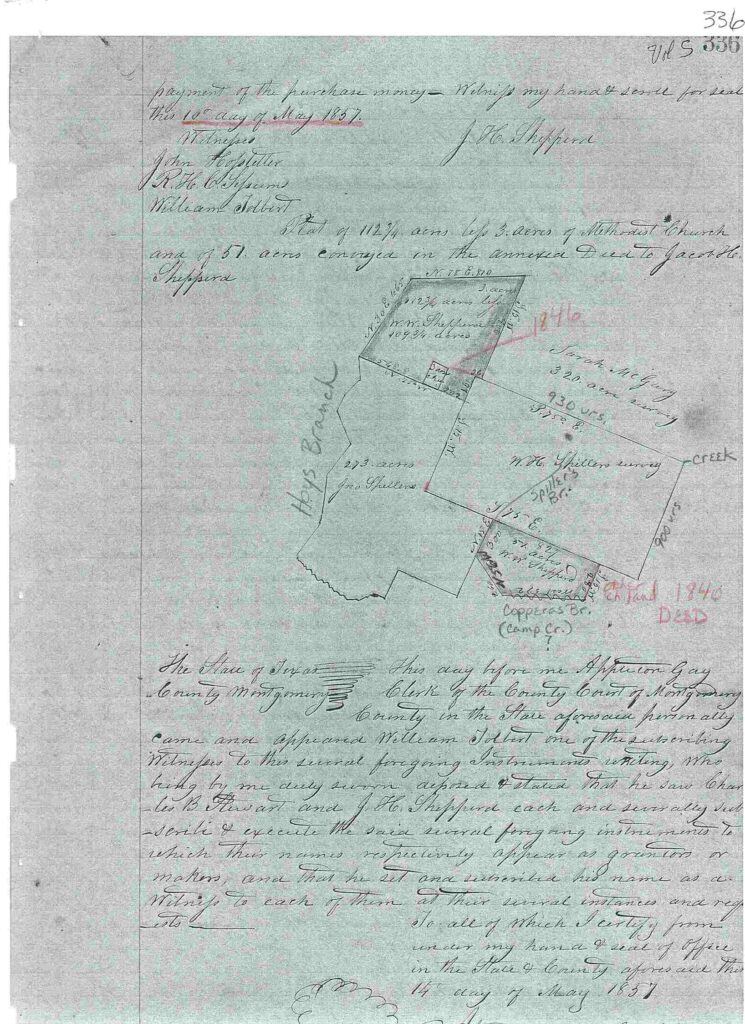
The original owner of the land on which the cemetery is located was Joseph Lindley. He emigrated from IL and obtained his land ca. 1835 when Texas was governed by the Spanish under Mexio. His land grant encompassed over 4,000 acres and he began partitioning it off through sale or donation within five years. In 1846, he donated 3 acres to the Trustees of the Methodist-Episcopal Church, (Montgomery Co., TX Deed Records, Vol. L:234-235). The Trustees were William Cude, James M. Smith, Daniel Robinson and Thomas W. Hoy. The deed states Lindley’s intent that the church building be used by other Christian denominations when not being used by the ME congregation. This 3-acre church tract is the location of the area we now know as the Old Danville Cemetery, aka Shepard Hill Cemetery. It probably also includes some of the eastern part of the Catholic Cemetery section. At the same time, Lindley sold the land on three sides of the church tract to William Waters Shepperd, Jr. (112-3/4 acres, less the 3-acre Church tract = 109-3/4 acres). This 109-3/4 acre tract was key in following the sequence of events that detail the evolution of the cemetery lands. The land to the south of the Church tract was sold to John Spillers in April of 1846
Chain of Title ~
Tracing the chain of title was challenging because there is no deed made directly to the cemetery. More than likely, the burials were started on the grounds of the church and at some point the church ceased to exist. The tracts of land surrounding the cemetery were sold; usually “excepting” (excluding) the 3-acre church tract. It was by following the chain of title to these surrounding tracts that the true history began to be revealed. Following is the chain of events that reveal the history of the cemetery lands in the shadows:
1. Joseph Lindley and wife to W. W. Shepperd, Jr., 5 May 1846, Montgomery Co., TX Deed Records, Vol. L, pg. 232-234. Two tracts: 109-3/4 ac. (this is the tract that surrounded the 3-acre Methodist Episcopal Church) tract and 51 ac. tract.
2. Joseph Lindley to The Trustees of the Methodist Episcopal Church, 3-acre tract, dated 6 May 1846, Vol. L, pg. 234-235.
3. W. W. Shepperd, Jr. dies in 1846. (Black Box Packet No. 247; Abstract in Probate Records, Vol. 1, p. 87-88.
6 AUG 1850 – First marked burial: Mary Susan Spiller
1852 – Second marked burial: Green Wooten Taylor
1854 – George Spiller and Michael Weisinger
4. Law suit over land between Shepperd Jr.’s widow (by her father, Abel H. White) and W. W. Shepperd, Sr. 1846-1857. Judgment of the Dist. Court of Montgomery Co. and the Supreme Court of Texas. W. W. Shepperd, Sr. gets land. (Black Box Packet No. 247; Abstract in Probate Records, Vol. 1, p. 87-88. See also, Co. Court Probate Minutes Bk F:413-414.)
5. W. W. Shepperd, Sr. died in 1849. Probate in Black Box packet #319. Two tracts included. Described as “112-3/4 acres (less 3-acres held by the Trustees of the Methodist Church) leaving 109-3/4 acres; and 51 acre tract….” (Deed Records, S:334-336) Plat found in Black Box Packet No. 319, County Clerk’s office, Probate Dept., Conroe, Montgomery Co., TX.
6. C. B. Stewart (Adminstrator of W. W. Shepperd, Sr. estate) to Jacob H. Shepperd, dated 10 May 1857, Vol. S, p. 334-337. 112-3/4 ac. Less 3 acre Methodist Church tract, and 51 acre tract (total 160-3/4 acres). Also, see Indenture from J. H. Shepperd to C. B. Stewart as Administrator of Est. of W. W. Shepperd, Sr. for payment of same, Vol. S, p. 338-340, dated 10 May 1857. This is an agreement for payment.
7. J. H. Shepperd to S. R. Smith, dated 9 Dec 1859, Vol. V:59-60. Deed for the two tracts. Apparently, Samuel R. Smith was acting as security for Jacob’s debt on the land.
8. S:477-478, dated 10 May 1857. Mary S. Shepperd, widow of W. W. Shepperd, Sr. takes the note from Jacob H. Shepperd for mortgage on both tracts (112-3/4 less 3 ac. church tract and 51 ac. tract) as a portion of her part of W. W. Shepperd Sr.’s estate; so Jacob is now paying her a mortgage for the two tracts of land, but Jacob holds title to them.
9. See also, Vol. S:323-328 re: Trust drawn up by Mary Shepperd, (Mary S. Shepperd to James E. Scott and Gwyn Morrison) dated 11 May 1857; puts into Trust the promissory note executed by J. H. Shepperd and S. R. Smith in favor of C. B. Stewart, as administrator of Est. of W. W. Shepperd, Sr., dec’d….for the purchase money of two tracts of land, one of 112-3/4 acres and the other 51 acres, bought by said Jacob H. Shepperd at the Estate sale of the Est. of said W. W. Shepperd, Sr…and also…that certain mortgage dated 12 May 1857 executed by Jacob H. Shepperd in favour of C.B. Stewart as Administrator of said Est. upon the 112-3/4 acres of land less three acres belonging to the Methodist Church, leaving 109-3/4 acres…and 51 acres in the other tract…(see No. 6 above).
10. Vol. U:782-785, dated 20 Jun 1857, James E. Scott and Gwyn Morrison For Mary S. Shepperd To C. B. Stewart. The Trustees of Mary Shepperd’s Trust appoint C. B. Stewart as Trustee.
11. Vol. U:778-781, dated 25 Jun 1861, Mary Shepperd to C. B. Shepperd. This is giving C. B. Shepperd more powers to manage the property in her Trust (which includes mortgage owed on the 2 tracts of land by Jacob H. Shepperd).
12. Mary S. Shepperd dies in 1863. Probate in Walker Co., TX
13. J. H. Shepperd to J. Carroll Smith, dated 18 Apr 1863, Vol. U, pg. 761-762. Jacob H. Shepperd is selling all of his interest in his mother’s estate to J. Carroll Smith for $600.
14. J. Carroll Smith to Hamilton O’Banion, V:61-62, dated 16 Oct 1863. Payment was made to C. B. Stewart and a note was made to J. C. Smith for the balance due of the purchase monies due him on tract of land…being the same conveyed to J. H. Shepperd by Deed S:333-336, (160-3/4 ac.), subject first to the payment of balance due on a Judgement in the Dist. Court of Montgomery Co. in favor of Mary S. Shepperd against J. H. Shepperd and S. R. Smith rendered 22 Nov 1860 and then to the payment of said O’Banion’s note to J. C. Smith by virtue of the Vendor’s lien for unpaid purchase money.
15. O’Banion bankrupt on 26 Dec 1868, Vol. X:486.
16. X:486-488. L. T. Harris, assignee of the bankrupt estate of Hamilton O’Banion to James A. Hill, dated 23 Sep 1869. Land now referred to as 160 acres of land. Clearly the same land as prior deeds are referenced. Land still subject to Vendor’s Lien in favor of J. C. Smith for $650.
17. James A. Hill to William F. Spiller and Susan J. Spiller, Vol. 2, p. 277-278, dated 29 Dec 1875. “163 acres… known as the Hamilton O’Banion place near the Town of Danville…same land conveyed to said O’Banion by J. C. Smith by deed dated 16 Oct 1863 (Vol. V, p. 61-62)… and same 163 acres of land sold and conveyed to Hill by L. T. Harris, assignee of the bankrupt estate of said Hamilton O’Banion by deed dated 23 Apr 1869 (Bk. X, pg. 486-488)…” (The acreage indicated in this deed apparently includes the 3-ac. Church tract).
18. Susan Spiller dies in 1898. Her estate inventory lists “1/2 interest in 163 acres in the Joseph Lindley Survey – Graveyard.”; All property bequeathed to her son, William F. Spiller.
19. William F. Spiller dies 1913.
20. Partition of estate of Susan J. Spiller by the Spiller grandchildren. Chas. Spiller, et al to W. F. Spiller, et al, dated 10 Aug 1918, Vol. 94, p. 497. A (50 acre) tract to Mrs. Irmalie (Spiller) Tyree goes to a “S. E. corner of the M. E. Church lot, a S.W. corner of the Sarah McGary 320 ac. survey and a corner of a 163 ac. survey made for W. F. Spiller. A stake in Danville and Longstreet Road for corner.” This is the land on either side (east and west) and south of the 3-acre church tract/cemetery.
21. On 2 Dec 1938, Irmalie (Spiller) Tyree and husband, L. E. Tyree sell to Dr. W. F. Spiller, Jr., Vol. 203, 189-190, 50 acres. (See No. 20 above).
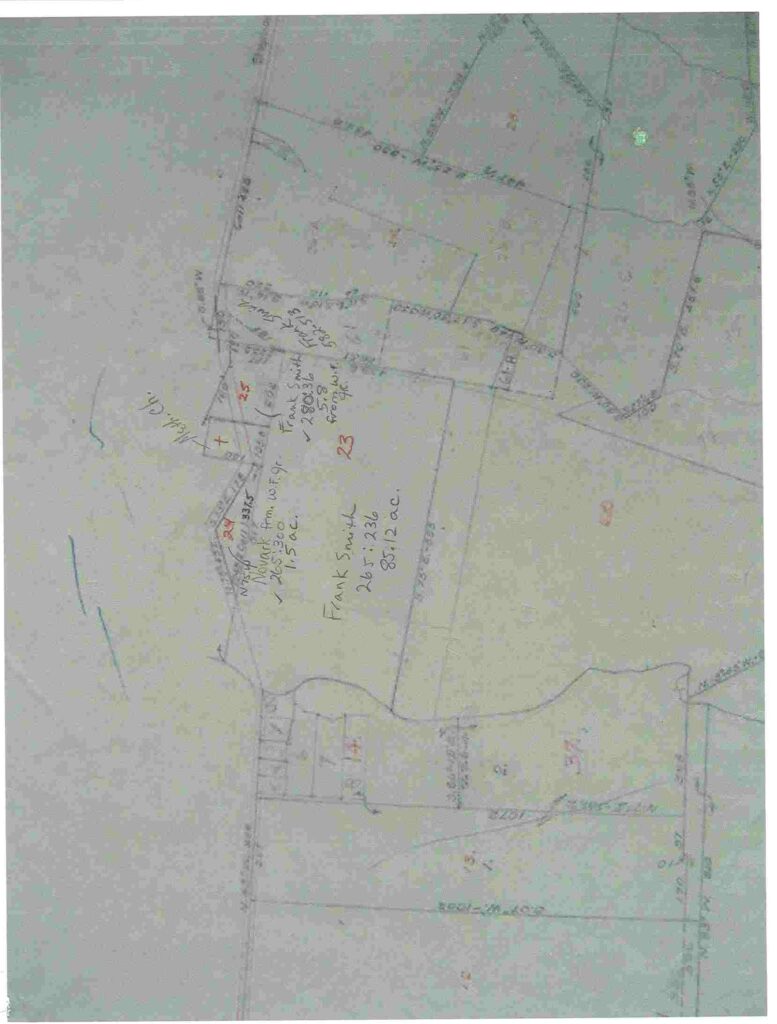
22. Tract 24-South (located west of the 3-acre church tract) is 1.5 ac. referenced by Vol. 265:300. This was a deed from Dr. W. F. Spiller, Jr. to David Novark out of Spiller’s 204.8 ac. tract, dated 1947 (W. F.’s 163 ac. tract (located north of the church tract + 41.65 ac tract W. F. bought from the Tyrees (See No. 21 above). This deed CLEARLY excludes the acreage on the west side of the church tract, thus adding additional acreage to the original church/cemetery land. Early Appraisal District maps also show that this land has become part of the cemetery lands.
23. Tract 25-South (located east of the 3-acre church tract) is 5.8 acres referenced by Vol. 280, pg. 36. This deed is from Dr. W. F. Spiller, Jr. to Frank and Martha Smith, dated 28 Apr 1948 and one of the lines of this tract is set in the “South East corner of a certain 6.1 acre cemetery tract” showing that by 1948, the 3-acre church tract had evolved into a 6.1-acre cemetery tract. Appraisal maps also clearly show the original 3-acre church tract directly west of and adjoining Tract 25-South which proves that the Old Danville Cemetery is on the land of the original 3-acre Methodist-Episcopal Church tract. Land measurements have shown that part of the east side of the Catholic section is also sitting on the original 3-ac. Church Tract.
ARTICLE TITLE
BODY OF ARTICLE
ARTICLE TITLE
BODY OF ARTICLE
ARTICLE TITLE
BODY OF ARTICLE